
>> Versione italiana <<
Why the Madonna comes down to the city
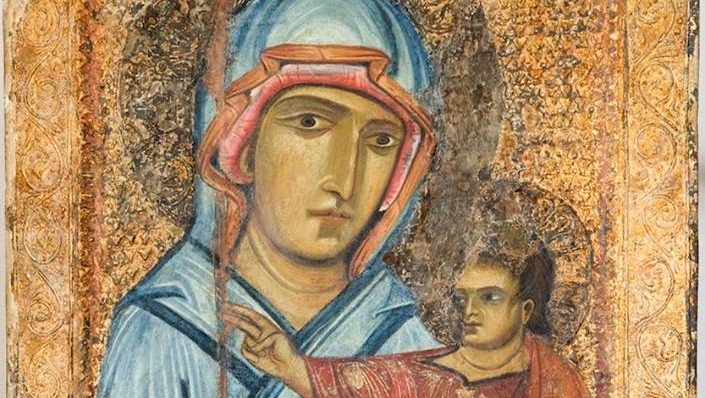
Every year, the week before the Ascension, the Icon of the Madonna of San Luca comes down to the city from the Colle della Guardia where it is usually placed in the sanctuary dedicated to her.
The story begins like this…
in Bologna, in the spring of 1433, incessant rains threatened the harvest and promised famine.
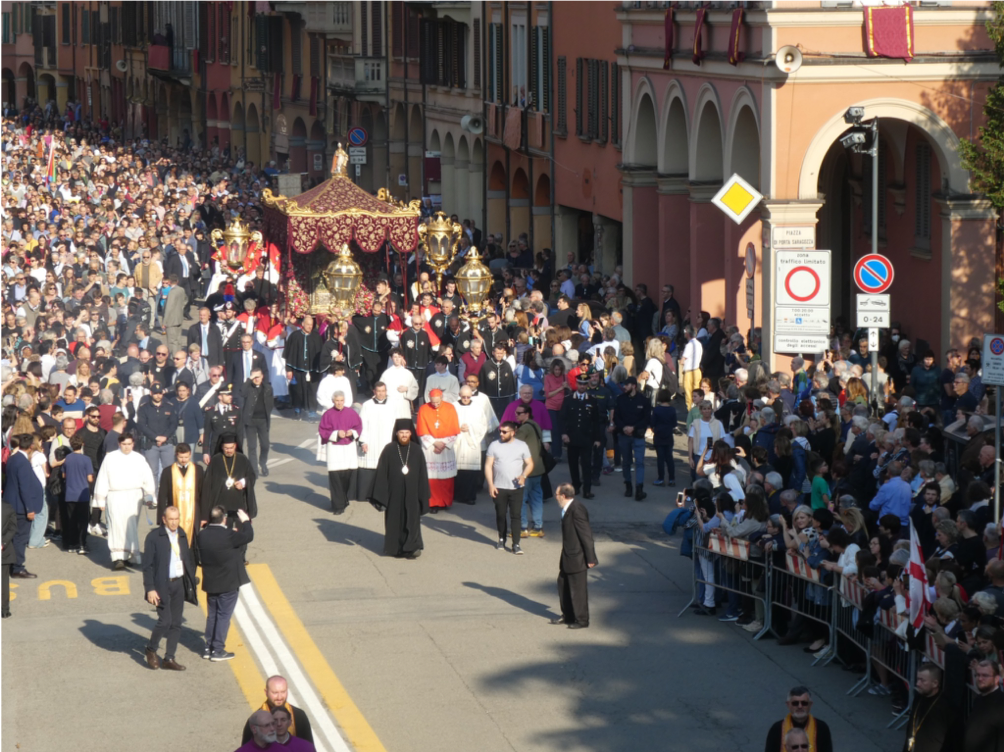
The jurist Graziolo Accarisi, a member of the city government, thought that, imitating what was happening in other cities, the people of Bologna should also turn to the Madonna of San Luca. The city government was happy to agree, and the task of going up to the hill to get the icon was entrusted to a Confraternity that took care of the dying, called the Confraternity or Company of Death. The brothers went up to the hill, under incessant rain, took the icon and went back down to Bologna.
They stopped at the gates of the city, now closed, at the monastery of the Dominican nuns of Santa Maria Maddalena di Valdipietra (just outside Porta Saragozza: today there is the parish of San Giuseppe Sposo di Maria). They spent the night there, and the next morning, the dawn of July 5, 1433, when the icon carried by the brothers of the Company of Death entered the city, crossing Porta Saragozza, the clouds thinned and a ray of sunshine promised salvation to the people of Bologna.
The icon was carried in triumph through the streets for three days, then it was accompanied back to its church on the Hill: the Government vowed to repeat every year, in perpetuity, as a rite for grace received, the descent, the triumphal path and the solemn ascent.
In 1476, the lord of Bologna, Giovanni II Bentivoglio, ordered that the entire rite be performed for the Rogations (prayers) of the Ascension in May: this was to allow the people of the countryside, busy with the harvest in July, to participate easily.
Since 1433, every year, the rite has been repeated (with only two exceptions due to physical impediments), and moreover the Venerated Image was brought to the city several times to ask for special graces or on particular occasions, such as the end of the Second World War (1945) or the entrustment of the city to the Virgin (in 1988).
Plan
- On Saturday 24 May 2025 at 6:00 pm the image of the Madonna is welcomed at Porta Saragozza and accompanied to the Cathedral.
- On Sunday 1 June at 5:00 pm the image of the Madonna of San Luca is accompanied from the Cathedral to the Sanctuary dedicated to her.
At this link you can find the complete program:
History of the image
The icon of the Madonna of San Luca arrived in the city towards the end of the 13th century, leading to the birth of the Sanctuary of the Madonna of San Luca in Bologna. Carried by a pious pilgrim, the image was later entrusted by the city’s leaders to the nuns of a convent on the Colle della Guardia, who adorned it with flowers and jewels. A revered object of popular devotion, the icon depicts an odigeous Madonna and Child in classic oriental iconography, resulting from increased contact between eastern and western culture.
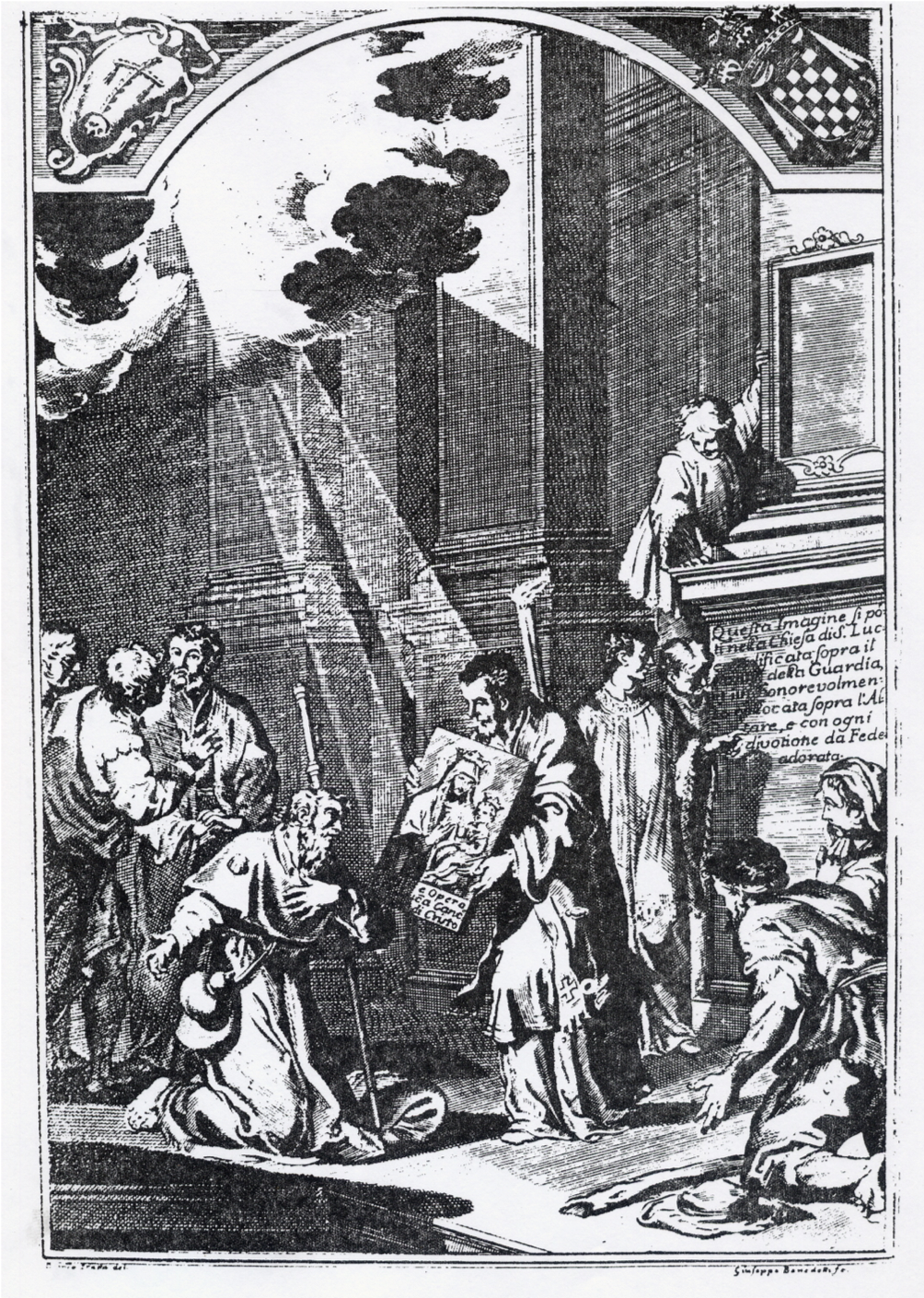
Various sources attest that the origin of the Bolognese sanctuary can be traced back to a Bolognese woman of good family who requested that the pontiff build a place of worship on Monte della Guardia. It is said that Pope Celestine III sent the first stone of the new building to the bishop of Bologna in 1193, mandating that it should be placed on the mountain to commence construction on the oratory. A few months later the bishop of Bologna, Gerardo Gisla, laid the foundation stone on 25 May 1194. Thus began a Christian adventure that continues to play an important role in Bolognese culture. Every May, the Madonna of San Luca is celebrated by a procession that carries the venerated icon down the mountain and into the city. The seal addressed to Pietro on 2 July 1228, prior to the church of Santa Maria del Monte della Guardia, testifies to the origins of the church’s name. Equally important is the seal of the Chapter of the Chiesa del Monte, also from 1228, which includes the image of the Madonna and Child. A seal that references, for the first time, the icon itself.
Faithful pilgrims maintain a common belief that, after prolonged observation of the sacred icon within the Sanctuary of the Madonna of San Luca in Bologna, one feels followed by her maternal gaze. This feeling is especially strong when approaching the icon from the staircase leading up to the altar.
History of the sanctuary
Since 1100 A.D. sources have referred to a hermitage located on this hill, famous for a specific hermit called Euthymius who arrived from Constantinople carrying a cedar board with an ancient Byzantine image of the Virgin painted upon it. In 1149 the hermitage passed to two sisters, Azzolina and Bice, daughters of Rampertino di Gherardi di Guezo.
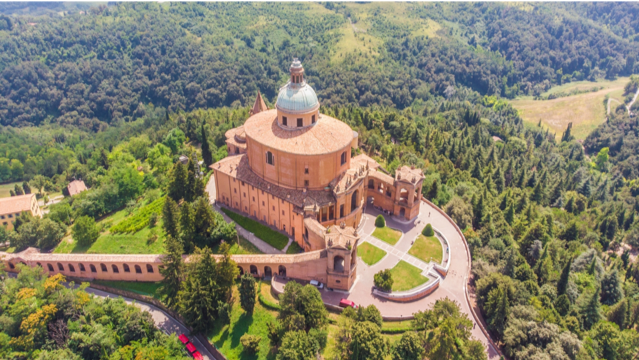
The two sisters were joined by other young women who wished to spend their lives in prayer. In 1741, with the consent of the Municipality and many devoted benefactors, construction began on the Sanctuary as we see it today. Designed by Carlo Francesco Dotti, construction was nearly completed by 1757, while the façade foundations and side galleries were installed soon after. The building, circular in shape with short Greek cross arms, has a single nave and a grandiose appearance created by the large drum supporting its majestic dome. The paintings inside are from the 17th-century Bolognese school and include works by excellent artists such as Guido Reni (who painted a wonderful Madonna del Rosario found in the third chapel on the right), the Bigari, Giovanni Viani, Nicola Bertoni, and other notable local artists. The sculptures were provided by Angelo Pió and Cometti, the latter being responsible for the two beautiful statues of San Luca and San Marco on either side of the main entrance. The central altar was erected in 1815 according to a design by Venturoli, and richly decorated with marble and bronze.
Behind the presbytery, you can enter an apse via a small staircase to reach a small niche containing the precious icon. The sacred image is a pilgrimage destination, not only for devoted Bolognese who reach it by following the long portico, but also for pilgrims traveling from all over the country.
The Sanctuary is reached from the city center by following the world’s longest portico, beginning with the first arch at Porta Saragozza.